SPENDIFY
2nd place atlassian track winner
TIMELINE
DubHacks 2025 University of Washington Hackathon
October 16th - 19th
Total: ~24 hours
TOOLS
HTML/CSS
JavaScript
JSON
Jira Forge / Rovo AI
Chart.js /Node.js
MY ROLE
Team of 4 Students
Worked on frontend development, UI format, feature implementation, & data visualization.
HACKATHON DETAILS
Track Chosen: Atlassian
Prompt
Tackle real-world collaboration, productivity, or DevOps challenges by extending Atlassian tools like Jira, Confluence, Bitbucket, and Trello. Show us how you can make work smarter, faster, and more fun with Forge Agents!
Team Decisions
We extended Atlassian’s Jira by building a custom dashboard for student money management, using RESTful APIs to connect Jira with our backend services, AI agents, and charting logic.
PROBLEM SPACE
College students often manage money independently for the first time while juggling tuition, rent, food, and social expenses. Income is frequently inconsistent, coming from part-time jobs, internships, or financial aid, which makes traditional budgeting tools feel rigid and difficult to maintain.
Through informal conversations with peers and observation of existing tools, we identified three recurring issues:
Students track expenses but struggle to athe data
Budgeting tools lack personalization and contextual feedback
Financial stress persists even when students actively try to budget
These challenges informed our decision to design a tool that prioritizes clarity, flexibility, and guidance rather than strict enforcement.
USER & RESEARCH INSIGHTS
Target Users
College Students
First Time Budgeters
Students with irregular or variable income
Research Approach
Due to constraints of hackathon, we grounded our decisions in:
Informal Interviews
Personal Experiences
Competitive analysis of existing budgeting tools
Key Insights
users want fewer, clearer categories
Visual summaries are more approachable than raw transaction lists
Guidance is most effective when it feels supportive
GOALS & SUCCESS CRITERIA
Our primary goals were to:
Help users quickly understand where their money is going
Reduce cognitive load when managing finances
Encourage reflection and better decision-making
Success was defined qualitatively by whether users could:
Categorize income and expenses without friction
Identify spending patterns at a glance
Receive feedback that felt relevant and actionabl
CONSTRAINTS & TRADEOFFS
Building Spendify during a hackathon introduced several constraints:
A highly limited timeline
Learning Jira Forge and Rovo AI during development
Navigating Jira’s deployment and integration workflow for the first time
These constraints required us to prioritize core functionality and defer advanced features. We made intentional tradeoffs to ensure the product worked reliably, even if some ideas remained conceptual
DESIGN PROCESS
Ideation:
We began by mapping common budgeting frustrations among students, focusing on emotional pain points such as stress and uncertainty. This helped us prioritize features that reduced overwhelm rather than adding complexity.
Information Architecture:
We structured the product around three core actions:
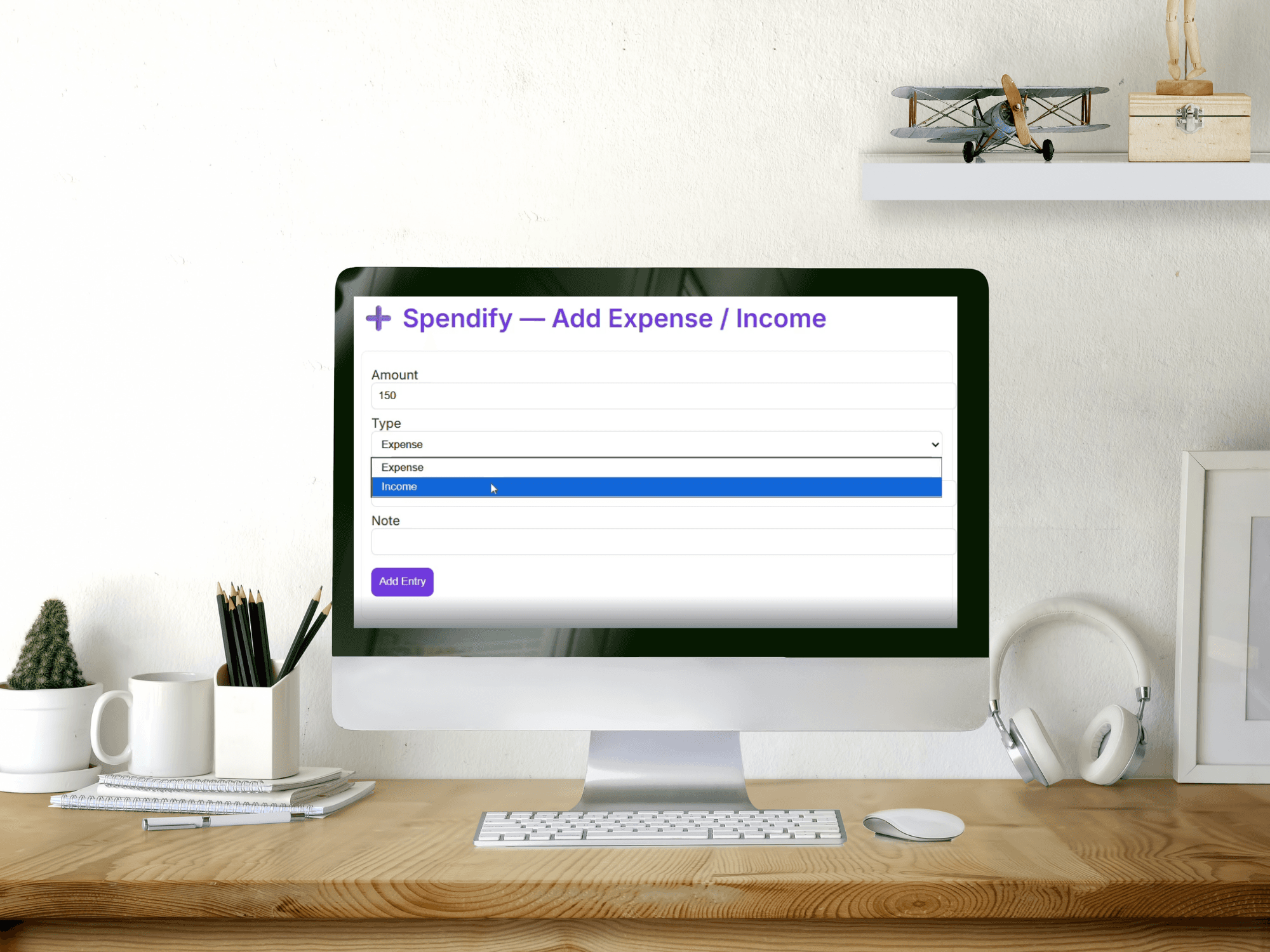
Input: logging income and expenses
Understanding: visualizing spending patterns
Reflection: receiving feedback and suggestions
This structure guided both layout and navigation decisions.
Iteration:
Design and development were highly iterative. We frequently adjusted UI components based on technical feasibility and usability considerations, refining interactions to remain intuitive under time pressure.
VISUAL DESIGN SYSTEM
Color Palette:
The color palette was designed to feel calm, approachable, and trustworthy. We avoided harsh contrasts and aggressive colors often associated with finance tools.
Primary colors emphasized clarity and focus
Neutral tones supported readability
Accent colors highlighted key data points without overwhelming the user
Purple: 770AF5
lighter tones used
to denote charts
Blue: 64A1ED
Primarily used in
charts
White: FFFFFF
Primarily used as
background
Black: 000000
Primarily used as
text color
Typography:
We selected clean, highly legible fonts to support quick scanning and reduce cognitive load.
Headings emphasize hierarchy and structure
Body text prioritizes readability
Consistent spacing reinforces clarity
Roboto
Heading 1
Roboto
Heading 2
Roboto
Body
The quick brown fox jumped over the lazy dog
0123456789
!@#$%^&*()
KEY FEATURES
Categorical Expense & Income Tracking:
Spendify allows users to log income and expenses across customizable categories. This approach breaks spending into understandable components, helping users move away from viewing finances as a single, opaque number.
Visualized Expense Tracking:
Interactive charts translate raw financial data into visual patterns. These charts help users quickly identify trends, imbalances, and opportunities for adjustment without requiring financial expertise.
AI College Financial Coach:
The AI chatbot acts as a college-focused financial coach, offering contextual suggestions and feedback. Its purpose is to encourage reflection and improvement rather than enforcement, aligning with how students prefer to receive guidance.
CHALLENGES
Throughout development, we encountered technical and conceptual challenges:
Configuring Forge and understanding deployment behavior
Connecting backend logic with a custom UI
Balancing ambition with feasibility
Each challenge required rapid problem-solving and reinforced the importance of prioritization.
IMPACT
Spendify was designed to support students’ transition to financial independence by:
Reducing stress through clearer organization
Improving financial literacy via visualization and feedback
Encouraging sustainable money management habits
While the project was not deployed beyond the hackathon, it demonstrates a scalable approach to student-focused financial tools.
FUTURE OPPORTUNITIES
Given more time, we would expand Spendify by:
Conducting usability testing with a broader student audience
Refining onboarding for first-time users
Adding goal setting, alerts, and reminders
Exploring mobile support for increased accessibility
Implementing gamification to reinforce positive behaviors
REFLECTION
Spendify challenged me to balance design thinking, technical execution, and real-world constraints in a fast-paced environment. The project reinforced the value of user-centered decision-making, iterative development, and building systems that prioritize clarity over complexity.